Options Value
The important thing when trading options is the PREMIUM we will pay (if buying) or receive (if selling) for the option. The option premium is a measure of what the option is worth at that point in time - its value. Thus it is quite important that we are able to determine the option's value.
1. Intrinsic Value
There are two parts to an option's value. The first involves no uncertainty, we can just calculate it. This is the value inherent in the
position that the option will give us at this point in time should the option be exercised. In other words, the value that the futures contract
will have right now if we convert the option into the futures position. This value (if any) is inherent to the option at this point in time, no
one can take it away. Note that it can be zero - nothing - no value.
It is easy to calculate. Remember a CALL will give you a LONG Futures and a PUT will give you a SHORT Futures. Thus, for a
CALL, if the Futures
price at this point in time trades less than the Options Strike Price, it offers no value. It is of no use
being able to buy (strike of the option) at a price
higher than where the market is trading. In this case the intrinsic value of the option is zero - no value. We say that the option is
OUT OF THE MONEY. However when the Futures trades above the strike of
the option, then immediately the option
allows us to buy the futures at a price less than where the market is trading, we may realise an immediate profit from the option, (the profit
is equal to the difference in price multiplied by the point value of the futures). We say that the option is
IN THE MONEY. When the futures price trades at the strike the option is
AT THE MONEY - it is about to start making us money.
For a
PUT option it is just the opposite.
The PUT allows us to sell the futures. Thus, if the futures trades above the strike, there is no value in
selling low and buying high, the option
is OUT OF THE MONEY, the intrinsic value is zero. As the futures price start dropping and reaches the option strike price, the option is AT THE
MONEY - still no intrinsic value but we are getting there. As the futures price drops below the strike
price, it becomes worth the while to
sell above the market and buy at a lower price, the option is moving INTO THE MONEY.
DEEP IN THE MONEY: Should be clear, except that what is DEEP for me might be different than what is deep for
you.
FAR OUT OF THE MONEY: Likewise, the futures price is still far away from the options strike price.
2. Time Value
The first part to an option's value - Intrinsic value - is easy, we can just calculate it from the futures price relative to the option's
strike price. The second part of an option's values is more subjective, it is uncertain...
It involves risk. And what is risky for me, may be less (or more) risky for you - thus my perception of what this value should be will be
different from your perception of the same value.
An option fixes the price at which the futures will be traded! Now let us take this from the point of view
of the guy that wrote the option, who sold the option to someone. This person received a premium for guaranteeing the buyer a price at which he
(the buyer) may obtain the futures position. The maximum profit that the seller can make out of this transaction is fixed - the premium he has
received. Now as long as the futures price stays away from the option's strike price - the price that was fixed - we will reach a point at which
the option will expire and since there is zero intrinsic value that option will expire with no value - the option will
EXPIRE WORTHLESS! As the futures price reaches the option's strike and starts moving beyond it, the option
starts gathering intrinsic value. Now the seller of the option starts worrying - he is the one that has to dish up this value!! (Remember that
when the option gets exercised, the seller has to take the opposing position in the futures). Thus the intrinsic value starts eating into the
seller's profit - the premium he collected. Up to the point when the seller reaches break-even. From this
point onward, the seller starts making a loss - the (intrinsic) value of the option, which the seller guaranteed, now starts exceeding the premium
the seller received for taking this risk. And that risk is UNLIMITED! The futures can move as far as it
wants to, there is nothing the seller can do about it, however he will get the - now highly unfavorable to him - opposing futures position on
options expiry date - and will have to dish out the difference.
For the purchaser of the option this of course is good news! He paid
a fixed price (premium) for the option, his risk, his loss, is fixed - he can loose no more than the premium
he paid. However his profit potential is UNLIMITED!
Now this
may sound fantastic, but be
carefull!!
OK, so what should be clear, is that the seller is taking a risk with writing the option. And therefore he will demand a
certain PREMIUM to be paid to him for taking the risk. And anything that will influence the riskiness of
this transaction will have a direct impact on the premium - the price, the value, that is attached to the option. We call this component of the
value, the TIME VALUE of the option.
And therefore:
OPTION VALUE = INTRINSIC VALUE + TIME VALUE
How do we calculate "Time Value"?
If there was no time left, then the futures price could not move and everything would be certain! But then you will not need an option, you may just trade the futures. Time is the enemy here to the options seller. Time means uncertainty, anything can happen, and anything that will influence the likeliness of the futures moving closer to the strike price, or futher beyond the strike price, will influence the riskiness of the transaction and therefore the premium to be paid for the option. There are three factors you need to consider:
1. Time to Expiry
This should be obvious. The more time until we reach expiry date, the more time the futures price has to do something, the more opportunity there is for things to go haywire, the higher will be the "time value" and thus the premium to be paid for the option. As the time runs out, the time value will run out pretty fast until there is no more time and the time value becomes zero. Then only the intrinsic value of the option is left.
2. Futures Price
This should also be obvious. The closer the futures price is to the strike price, the higher the risk that it will exceed the strike price and the higher the premium will be. Gold right now is trading at $1200, having dropped from #1300 a couple of months ago. What is the chance that it will trade above $1220 in the next 30 days? And above $2000? It is easy to see that a $1220 strike price option carries a much higher "risk" than the $2000 strike option.
3. Volatility
This one has the biggest influence! This one is also the most difficult to quantify. Time you know - you know when the expiry date is.
Price you know. But volatility is all in the mind of the trader. Look at the two price charts below..
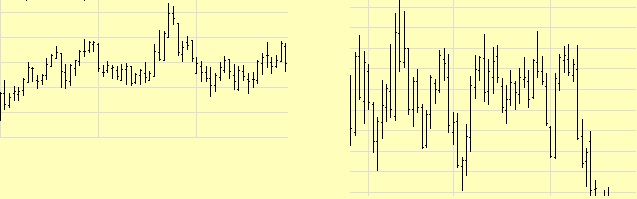
These are both the same commodity, same time of year, but different years (2014 and 2015). Now, the one on the left, the commodity is calm,
sedated, almost predictable. On the right it is troubled, wild, turbulent - it is volatile. The market on the left, you may venture into..
the one on the right you will be whiplashed up-and-down.. you need to be very brave (or foolish) to step into this one.. This is volatility
- how "turbulent" does the investor perceive the market to become - not how volatile it is at the moment (although that contributes to the
"feeling of unease"), but at the time when this option will expire. If investors expect turbulent times ahead, their perception of "riskiness"
will be high and prices will be high - if they expect the market to be cool and calm, their price expectation (riskyness) will be flat, calm
- the option will be cheap (relatively).
Think about driving through the countryside, you see the wheat, banks upon banks of them,
yellow, beautiful, waving in the wind. Everything is perfect. Then suddenly, news of impending thunderstorms, unexpected bad weather over
most of the wheat producing areas - investors get scared, expecting the worst, they are uncertain...few weeks later, everyone realize they
over-reacted and calm down again..- but you can see how unforeseen events play havoc with emotions, and the emotions leads to volatility in
the markets, feelings of uneasiness, perception of riskiness - equals high prices...
Black-Scholes
Mr's Black and Scholes struggled with the same question than you are struggling with. Taking all of the above into account, how do we
determine a fair (realistic) price for the option? They formulated a mathematical calculation that took all of the above into account and
does exactly that, and they won the Noble prize in Economics for it. Now whether you would like to agree or not with their formula (and note
there is much disagreement and a continuous search for alternative option pricing strategies), the fact is if you go into the market right now,
and enter the necessary parameters, the Balck-Scholes (B-S) formula is on-the-dollar spot on! Right now, if you would enter the market, you
will find the buyers willing to pay slightly less and the sellers asking slightly more than the B-S price. When a seller gives in and ask
slightly less and a buyer caves in willing to pay slightly more, a transaction takes place, and that transaction will be very close to the
B-S price.
We know the futures price and we know the option's strike price. We know how many days left to expiry. What we don't know is the volatility
and the price. If we could measure the volatility, we can calculate the price. Or if we know the price at which a transaction occurred, we
may calculate the volatility that that price implies. And thus we end up with a term, the
IMPLIED VOLATILITY. An option trading at a certain price, implies a certain volatility and vice versa a
certain volatility implies (or will result in) a certain price. The B-S formula is working exactly like that.
Initially, when no transaction has yet occurred we do not have a price or an implied volatility. Implied volatility is the
price volatility in the minds of the buyers and sellers at option expiry and we don't know that yet.
However we can calculate the historical volatility and use that, it will at least give us an idea of where the price should be trading at.
Thus, we enter
the market where buyers and sellers face off against one another. The sellers wants as much as possible, the buyers wants to pay as little as
possible and we have a stalemate. All you need to do is just throw enough buyers and sellers together and sooner or later someone is going
to work out a price that both parties can agree to and a transaction will occur. And at the end of the day there would have been many
transactions and we have an average price. And since we have a price, we can calculate Implied Volatility. Thus starting tomorrow, we know
the implied volatility (from yesterday) and we can calculate a fair price using the B-S formula. And now everyone has a guideline and buying
and selling can continue. Of course it is not to say that this Implied Volatilty is correct and it is not to say that every transaction has
to occur at the B-S price, but we have a guideline and we are able to continue. You and I are able to enter the market and we
have a guideline
to inform us on what a fair price will be. From here on you are on your own. You do not have to accept the B-S price, you can ask more, or you
may demand less. If you can find another party out there willing to meet you at your terms, then great - you have participated in shifting the
B-S price and the implied volatility to a different place!
The Greeks
When I hear about the 'greeks', I involuntary think back to the town I grew up in, a small town. The Greek had the cafe on the corner -
ohh that smell of the freshly baked chips with salt and vinegar in the brown paper bag. The greeks owned all of the corner-cafe's, they and
the Porra's, as well as the vegetable shop! Mmmm.. OK, not these "Greeks"..
There are a couple of mathematical values we may derive from out of the Black-Scholes formula, these parameters have been given greek symbols -
alpha, beta, gamma, delta, etc. and from there the term. There are probably a number of these that are important to the serious opions trader,
however I have found value in only two of them:
DELTA - tells us by how many points (note points - you have to multiply
points with the point value of the futures to get monetary value) the price of the option will change when the futures' price changes by
ONE point. Got that? If the futures go up by one point, by how much will the option's value change (in
points). The good news is this value is always a fraction between 0 and 1!
This is very important to note! The option will never change in value faster than the underlying futures will change in value!!
(Basically, delta for a far out of the money option will be small (less than 0.1) and it will slowly increase to around 0.5 for an at the money
option and keep on increasing and be high (more than 0.9) for a deep in the money option)
THETA - of an option will tell us by how many points the value of the option will
depreciate for every day of time that is lost! Remember as the days go
by, there are less and less time available, thus less and less risk. Theta gives us a measure of how much value the option looses just because
of the time running out.
There are other greeks as well, you are welcome to research them, but I do not find any value in them. These
two are enough, they tell me how fast the time value runs out and they tell me what to expect as the futures' price changes.
Trading in Options and Futures
You now have enough background knowledge on these instruments to allow you to proceed to the trading pages. Use the link below.
Options
Maybe this was a bit much.. Well read through it a second time, use the link below to get back to our introduction to options page.